.svg)
.svg)
Guide to the EU Battery Regulation and the Battery Passport

.webp)

The EU Battery Regulation is the most consequential piece of product legislation the European battery value chain has faced, and the first to make a Digital Product Passport a legally binding obligation rather than a future ambition.
Formally Regulation (EU) 2023/1542, it replaces the 2006 Battery Directive with a full lifecycle framework covering everything from where raw materials are mined to how a battery is recycled at end of life. Carbon footprint declarations, recycled content thresholds, supply chain due diligence, removability rules and binding recovery targets all sit within a single instrument.
At its centre is the Battery Passport. From 18 February 2027, every electric vehicle battery, light means of transport (LMT) battery and industrial battery above 2 kWh placed on the EU market must carry one, accessible via a QR code printed on the battery itself.
That makes batteries the first product category in Europe to face live Digital Product Passport (DPP) requirements at scale.
The Battery Directive 2006/66/EC
The original Battery Directive, adopted in 2006, was a comparatively narrow instrument. Its focus was hazardous substances (restricting mercury and cadmium) alongside separate collection, take-back obligations and basic recycling efficiency targets.
As a directive, it required transposition into national law by each Member State. The predictable result was fragmentation: 27 slightly different interpretations of collection responsibilities, registration duties and reporting formats, which producers selling across the single market had to navigate individually.
It also said almost nothing about how a battery was made. Carbon intensity, material provenance, recycled content and durability were simply outside its scope, a significant gap once batteries moved from consumer electronics into transport and grid-scale energy storage.
In December 2020, the European Commission proposed replacing it. The result, adopted in July 2023, was a regulation rather than a directive: directly applicable in every Member State, with no transposition step and no room for divergence.
What Is The EU Battery Regulation?
The EU Battery Regulation entered into force on 17 August 2023, with the bulk of its provisions applying from 18 February 2024 and further obligations phasing in through to 2036.
Its scope is deliberately comprehensive. The regulation applies to various batteries placed on the EU market or put into service in the EU, regardless of whether they are supplied standalone or already incorporated into a product, and regardless of where they were manufactured. A cell produced in Asia and fitted to a vehicle assembled in North America is in scope the moment that vehicle is sold in Europe.
Like the Ecodesign for Sustainable Products Regulation (ESPR), its reach extends well beyond manufacturers. Importers, distributors, fulfilment service providers, waste management operators and anyone remanufacturing or repurposing a battery for second life carries obligations under it.
Which Battery Categories Does The Regulation Cover?
The regulation defines five categories, each with a different obligation profile:
- Portable batteries – the cells in consumer electronics, power tools and household devices
- SLI batteries – starting, lighting and ignition batteries, typically lead-acid
- LMT batteries – powering e-bikes, e-scooters and other light means of transport
- Electric vehicle batteries – traction batteries for road vehicles
- Industrial batteries – including stationary battery energy storage systems
Not every obligation applies to every category. Recycled content thresholds, carbon footprint declarations and the Battery Passport are targeted at the larger, higher-impact categories. Removability and replaceability rules, by contrast, are most applicable to portable batteries embedded in consumer products.
For example, Battery Passports are not currently required for small batteries (such as AA and AAA batteries) required to power smaller consumer electronics.
SMEs and smaller operators
The regulation recognises that compliance capacity is not evenly distributed. Small and medium-sized enterprises are exempt from the supply chain due diligence obligations in Articles 48 to 53, and Member States are expected to provide guidance and support for smaller operators more broadly.
A further simplification proposal would extend certain reliefs to a new “small mid-cap” category and narrow due diligence obligations to companies above a €150 million turnover threshold. That proposal remains in the legislative process and is not yet law; organisations near the threshold should track it rather than plan around it.
What Are The EU Battery Regulation's Sustainability Requirements?
The regulation sets binding requirements across eight areas. Together they define the dataset that ultimately populates the Battery Passport.
1. Carbon Footprint Declaration
- Manufacturers must calculate and declare a lifecycle carbon footprint for each battery model, per manufacturing plant.
- Declarations are phased by category, starting with EV batteries, followed by rechargeable industrial batteries and then LMT batteries.
- Figures must be third-party verified. Offsetting cannot be used to reduce a declared value.
- Performance classes and, later, maximum footprint thresholds will follow, meaning carbon intensity eventually becomes a market access condition, not just a disclosure.
2. Recycled Content
- From 18 August 2031, industrial batteries above 2 kWh, SLI batteries and EV batteries must contain minimum recycled shares: 16% cobalt, 85% lead, 6% lithium and 6% nickel.
- From 18 August 2036, those thresholds rise to 26% cobalt, 85% lead, 12% lithium and 15% nickel.
- Documentation of recycled content is required in advance of the thresholds themselves, giving the market visibility before the targets bind.
3. Supply Chain Due Diligence
- Economic operators must operate a due diligence policy covering cobalt, natural graphite, lithium and nickel.
- Policies must be third-party verified and cover risk identification, mitigation, grievance mechanisms and public reporting.
- Application was postponed by two years to 18 August 2027 under Regulation (EU) 2025/1561, largely because Member States had not designated the notified bodies needed to verify them.
4. Performance and Durability
- Rechargeable industrial batteries above 2 kWh, LMT batteries and EV batteries face electrochemical performance and durability requirements
- Parameters including capacity retention, round-trip efficiency and expected lifetime must be documented.
5. Removability and Replaceability
- From 18 February 2027, portable batteries in appliances must be readily removable and replaceable by the end user.
- LMT, EV and industrial batteries must be removable and replaceable by independent professionals.
- Limited exemptions exist, such as for devices requiring continuous water resistance, and further partial exemptions have been consulted on.
6. Collection and Take-Back
- Collection targets rise to 63% for portable batteries by the end of 2027 and 73% by the end of 2030.
- LMT battery collection targets are set at 51% by the end of 2028 and 61% by the end of 2031.
- Extended producer responsibility obligations apply, including registration and financing of collection systems.
7. Recycling Efficiency and Material Recovery
- Recycling efficiency targets of 75% for lead-acid, 65% for lithium-based, 80% for nickel-cadmium and 50% for other batteries applied from the end of 2025, rising for lead-acid and lithium-based batteries by the end of 2030.
- Material recovery targets require 90% recovery of cobalt, copper, lead and nickel by the end of 2027, rising to 95% by the end of 2031.
- Lithium recovery is set at 50% by the end of 2027, rising to 80% by the end of 2031.
8. Labelling and Information
- Batteries must carry labels covering capacity, chemistry, hazardous substances and separate collection.
- CE marking obligations apply, and from February 2027 the QR code linking to the Battery Passport becomes mandatory.
Understanding Digital Product Passport Requirements For Batteries
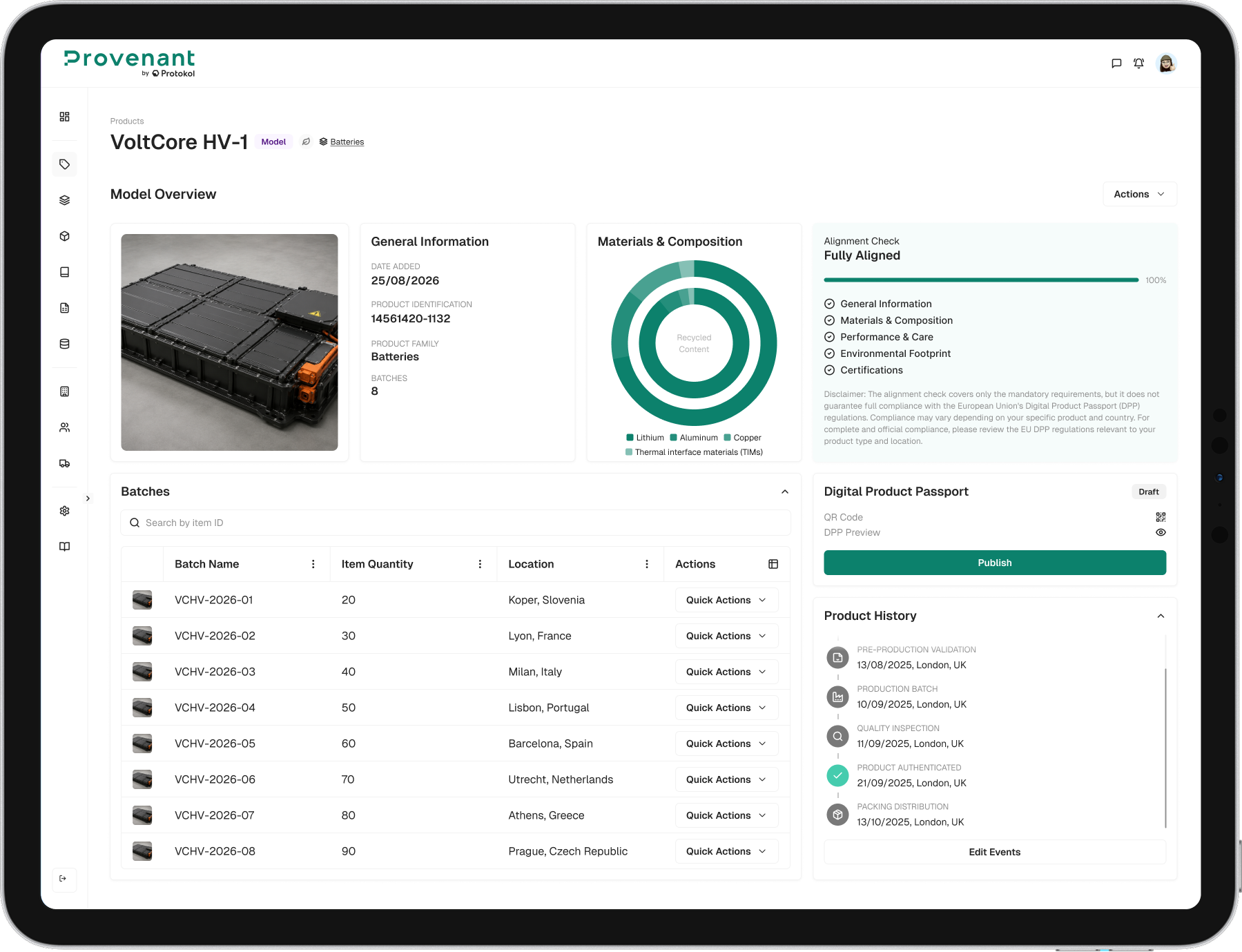
A Battery Passport is a structured, machine-readable data record linked to a physical battery through a unique identifier and QR code. It is created by the economic operator placing the battery on the market, and it must remain accurate and available throughout the battery's life, including after ownership changes hands.
There’s a very important distinction, and it is where most implementation projects underestimate the effort. The Battery Passport is issued per individual battery, not per model. A manufacturer shipping 100,000 units is issuing 100,000 passports, each carrying unit-specific data that continues to change after the battery leaves the factory.
The regulation specifies the dataset directly, drawing on information generated across the value chain:
- Battery identity – manufacturer, model, category, date and place of manufacture
- Composition – chemistry, materials, critical raw materials and hazardous substances
- Carbon footprint – declared lifecycle footprint and, in time, performance class
- Recycled content – documented shares of cobalt, lead, lithium and nickel
- Due diligence – supply chain policy and verification outcomes
- Performance and durability – rated capacity, expected lifetime, round-trip efficiency
- State of health – dynamic data reflecting the battery's condition in use
- End-of-life handling – dismantling, safe removal and recycling information
Layered Access
Unlike a static compliance document, Digital Product Passport requirements under the Battery Regulation are structured around who is reading. The regulation defines distinct access tiers: information available to the general public, information reserved for notified bodies, market surveillance authorities and the Commission, and information available to parties with a legitimate interest such as repairers, remanufacturers, second-life operators and recyclers.
The Digital Product Passport Registry Is Now Live
On 20 July 2026, the European Commission launched the central Digital Product Passport Registry, together with a testing environment. The Registry stores unique identifiers and registration metadata; the detailed product data itself remains with the economic operator or their DPP service provider.
Established under the ESPR, the Registry also serves product groups governed by separate legislation including batteries, construction products and toys. Commission Implementing Regulation (EU) 2026/1778 sets the rules for how it operates, covering access management, user verification and data registration.
Its practical significance for battery producers is straightforward: registration is no longer theoretical, a testing environment exists, and the identity verification step that precedes any passport registration can be started now rather than in the weeks before February 2027.
Key Milestones In The Battery Regulation Rollout
- August 2023 – Entry into force: Regulation (EU) 2023/1542 replaces Directive 2006/66/EC.
- February 2024 – General application: The bulk of the regulation's provisions begin to apply.
- August 2025 – Waste management obligations: Extended producer responsibility, collection and treatment duties take effect.
- July 2026 – DPP Registry goes live: The central registry and testing environment open, with the governing implementing regulation taking effect in August.
- 18 February 2027 – Battery Passport becomes mandatory: EV, LMT and industrial batteries above 2 kWh require a passport accessible via QR code. Removability and replaceability rules apply from the same date.
- 18 August 2027 – Due diligence obligations apply: Verified supply chain due diligence policies become mandatory following the two-year postponement.
- 2031 and 2036 – Recycled content thresholds: Minimum recycled shares apply from August 2031, rising in August 2036, alongside tightened material recovery targets.
Preparing For EU Battery Regulation Compliance: What to Do Next
With less than six months until the passport deadline, preparation is now an infrastructure question rather than a policy one.
1. Audit your data, honestly: Most organisations can produce a bill of materials. Far fewer can produce some of the more intricate, verified sustainability information required by the regulation with ease. Establish where the genuine gaps are before designing around them.
2. Resolve data ownership across the value chain: The most common blocker is not technology but governance: who supplies each field, who is accountable for its accuracy, and who is permitted to update it once the battery is in use. Cell suppliers, pack integrators, OEMs and second-life operators all need defined roles.
3. Build for serialisation and updates from the outset: Systems designed around model-level product records will not scale to per-unit passports carrying dynamic state-of-health data. Interoperability with the central Registry and support for layered access are baseline requirements, not enhancements.
4. Start the registration process now: Identity verification and registry enrolment have no product-category deadline of their own and can be completed ahead of the February 2027 obligation.
5. Seek expert support: Given the interaction between the Battery Regulation, the ESPR and the wider DPP framework, working with a specialist Digital Product Passport consulting firm and technology provider will shorten the path considerably.
First Steps Towards Compliance
Batteries are the first sector to face binding Digital Product Passport requirements, but they will not be the last. Organisations investing in Digital Product Passport readiness now are building infrastructure they will reuse as textiles, steel, furniture and consumer electronics follow.
At Provenant, we help organisations create, validate and manage EU Digital Product Passports at scale, on a platform built for compliance readiness, product traceability and circularity.
Alongside our internal expertise, Provenant has a dedicated, extensive partner ecosystem to support your implementation, from system integration through to specialist DPP consultancy.
With February 2027 approaching, the time is now – reach out to Provenant today.

%20EU%20DPP%20Registry%20-%20Public%20-%20V1.webp)


