.svg)
.svg)
What is the Circular Economy Act (CEA)? Rules, Requirements, and Implications of Digital Product Passports

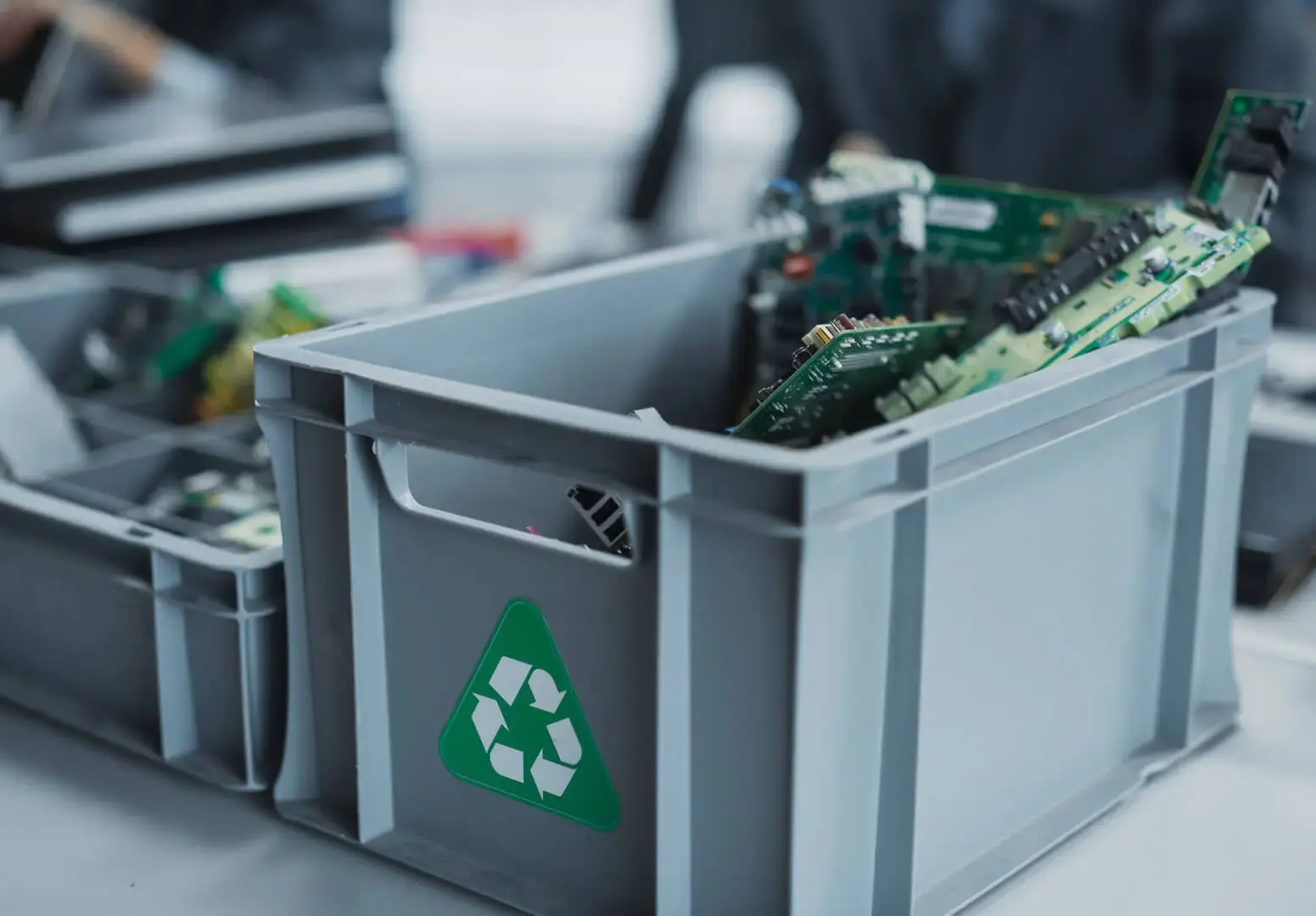

The EU’s Circular Economy Act is coming sooner than you think, and it’s not just about where to throw that empty pickle jar.
In an increasingly volatile world, the Act represents a permanent change for Europe’s industrial landscape, aiming to make it stronger and better in many ways. Digital Product Passports (DPPs) play a critical role in that change, providing the data infrastructure which enables circularity at industrial scale and across multiple industries.
What is the EU Circular Economy Act?
The Act is a legislative proposal from the European Commission and a central pillar of the Clean Industrial Deal. The Commission is expected to publish its Act proposals by September 2026. Thereafter, the Act will undergo negotiations and legislative approval processes within the European Parliament and Council.
Given the urgency of certain matters, such as the current rate of recovery for critical raw materials, the approval process is unlikely to be delayed and the implementation dates are likely to be set sooner rather than later – although no timeline for these later steps has been published at the time of writing.
The Clean Industrial Deal is the European Union’s flagship, strategic framework designed to align industrial competitiveness with decarbonisation, economic resilience and energy security. Introduced by the European Commission, the Deal aims to turn the green transition into an engine for growth, high-quality job creation, and lower energy costs.
While the Clean Industrial Deal is its flagship initiative, aligning decarbonisation with industrial competitiveness, the Competitiveness Compass is the EU's overarching strategy to boost economic growth, innovation, and open strategic autonomy. Together, they provide frameworks and concrete policies for European businesses, including the upcoming Circular Economy Act.
Therefore, the Act is different from an action plan: it is an instrument for achieving industrial competitiveness.
What are the aims of the EU Circular Economy Act?
The aims of the Act include: doubling the recovery rate for certain materials by 2030 (from 12% to 24%); and establishing a single market for secondary raw materials, thus replacing 27 separate national regimes.
To fulfil those aims, the Act’s measures are based on three pillars: (1) amending the Waste Framework and Landfill Directives; (2) amending the Waste Electrical and Electronic Equipment Directive; and (3) additional measures, such as the harmonisation of environmental taxes.
Why is the EU Circular Economy Act being implemented at this time?
If you were wondering why this is happening now, then consider some of the barriers and drivers of Europe’s competitiveness.
Recent shifts in geopolitical postures have highlighted Europe’s strategic vulnerability to the supply of certain raw materials. For example, the EU has an overall raw-materials trade deficit, yet recycling rates for lithium and rare earths are currently less than 1%.
The Act and its measures create the market conditions to make the recovery of those materials not only economically viable, it aims to establish a normalised recovery rate of 25%. Turning to planetary matters, resource extraction and processing are responsible for around 50% of global greenhouse gas emissions and 90 % of biodiversity loss. Thus, the Act is a crucial initiative to address those environmental pressures and their societal consequences.
Meanwhile at the product-level, 80% of a product’s environmental impact is locked in at the design stage. Therefore, well-functioning markets for both second-hand products and for resource recovery is crucial for relieving planetary pressures. And that’s where Digital Product Passports and eco-design converge: a single market for secondary materials needs a shared, machine-readable way to describe materials.
That's where Digital Product Passports come in.
What are Europe’s current sustainability challenges?
For better and for worse, a look at Europe’s collective sustainability status reveals a lot about our habits. On packaging, we are doing quite well as we already recycle almost 70%. In the majority of places, that empty pickle jar does not go to landfill, it gets recycled.
However, old electronics are still being recycled at just 30%, which is far below the Union’s long-standing 65% target. So many critical raw materials are going to waste! The surging demand for Electric Vehicles and other uses of large batteries will not solve the problem alone: legislative amendments are needed and are among the Circular Economy Act’s three pillars.
Another area of concern is textile recycling. The high volume of low-quality, blended-fibre fast fashion entering the EU has severely strained recycling systems. As sorting and recycling technologies cannot efficiently process mixed or low-grade synthetics, our collection systems are burdened with mountains of unsellable, hard-to-recycle waste.
Accordingly, Extended Producer Responsibility (EPR) schemes for textiles have been introduced in a number of Member States. However, those schemes have not been harmonised across the Union and their economics remain unviable.
More advanced than textile recycling, the Union’s 2025–2030 ESPR Working Plan (ESPR stands for the Ecodesign for Sustainable Products Regulation) already prioritises the vehicles, construction, plastics, and chemicals sectors
Because the Union’s DPP rollout is progressive, exact deadlines vary. For vehicles the Battery Regulation dictates the first mandatory DPP in February 2027. For construction products, the DPP registry goes live this year: product families, like cement, will see revised standards by late 2027.
Due to their relative supply chain complexity, plastics and chemicals will join the DPP ecosystem sometime between 2028 and 2030.
What will organisations need to do to comply with the EU Circular Economy Act?
As these changes will touch so many industries and revise so many processes, it is helpful to describe responsibilities in terms of corporate functions. What follows is a simplification, but it illustrates both a segregation of duties and how corporate functions will complement one another.
Starting with the ‘Sustainability’ function, their new focus will be measuring and reporting on circular material use, recycled content, product footprint, and resource-reduction targets. In a highly competitive, resource-constrained environment, those indicators will be an inherent part of risk management. More boldly, the function should explore Product-Service Systems and the implications for Sustainable Business Model Innovation.
Turning now to the ‘Compliance’ function, the harmonisation of waste legislation will reduce 27 rules into one and make life easier for trash management professionals and their advisors. On the other hand, tighter rules on Extended Producer Responsibility (EPR) and unfamiliar obligations for recycled content, green procurement and recycled chemical-safety will initially be a burden. However, before objecting to such burdens, it is worth recalling that those rules are a strategic response to global resource scarcity and price volatility.
Colleagues in the ‘Product’ function will need to become comfortable with the language of design-for-recyclability and design-for-disassembly. Green credentials, which were once a "nice to have" feature, will become product norms. Recall that 80% of a product’s environmental impact is locked in at the design stage, Therefore depending on lead-times and product replacement cycles, product decisions taken today may shape the corporation’s circular posture as early as 2028.
Lastly, the ‘Procurement’ function will need to have a much deeper understanding of supplier data about: origin; composition; and recycled content. Buyers and sellers will rapidly shift to common reporting standards for interoperable reporting systems. And data auditing will become systematic if not automatic. "We think it's roughly 30% recycled" may have been alright last year but will not clear the upcoming, regulatory hurdles.
Moreover, the Act applies to products placed on the European market, not just ‘Made in the EU’. Therefore, non-EU manufacturers are on the hook too and the Circular Economy Act will demand structured, verified, lifecycle product data. Unsurprisingly, DPPs are the EU's chosen vehicle. With that in mind, it is fair to say that “DPP-readiness is CEA-readiness”.
Recap: What are Digital Product Passports?
With so much of Europe’s strategic response resting on the shoulders of DPPs (Digital Product Passports), it is worth refreshing our minds with a short reminder about what these building blocks actually are.
A DPP is a standardised digital record for each product. It is accessed via a data carrier and covers identity, materials, origin, footprint, compliance, repairability, and end-of-life.
From a regulatory perspective, DPPs were mandated by the ESPR (EU 2024/1781), a framework which has been live since April 2026 and is building momentum nicely. The related ‘central registry’ is expected to land shortly and, as outlined above, the Union’s schedule for DPPs is progressive:
- iron and steel in 2026
- aluminium, textiles and tyres in 2027
- electronics, furniture and construction materials following close behind.
How does Digital Product Passport Readiness Help With EU Circular Economy Act Compliance?
Now that we are clear about the objectives of the CEA and the mechanics of DPPs, it’s time to reflect on how they map to one another. Here are five ways that DPPs map to compliance with the new Act:
- Auditable recycled-content claims: DPPs survive regulatory challenge and can therefore unlock green, public procurement.
- End-of-life traceability: DPPs facilitate provenance and treatment history as the data travels with the material.
- EPR fee modulation: product-level data makes recyclability-based fees automatable.
- Recycler enablement: role-based DPP access tells all recyclers what is really hiding inside each product.
- Anti-greenwashing: more than half of all green claims are either vague or unsubstantiated. DPPs provide what has been missing: the verifiable evidence layer.
What can your organisation do to prepare?
To prepare for the Circular Economy Act and its implications across corporate functions, here are my suggested next steps:
- Map your product portfolio against the ESPR Working Plan 2025–2030: that is your Circular Economy Act compliance timeline.
- Start with the data, not the carrier! The QR code is the easy part. The hard part is clean supplier data on product composition and origin.
- Pick a DPP architecture you can extend in the future. For example, what you build for batteries in 2027 will need to flex for electronics in 2029.
- Use one of your main product lines to as a pilot (test run) for your DPPs. This will help you iron out any issues and learn any lessons before a full implementation.
- Bring procurement in early. Without the early buy-in of procurement professionals, who will specify and pay for verified secondary materials, compliance will remain a defensive game. Bring them into your offence game and they will thank you for it.
Conclusion
For some time we have suspected that our traditional, linear economic model of 'take-make-use-dispose' could not last. The circular economy aims to break away from that linear model by keeping all resources in circulation for as long as possible. The Circular Economy Act turns those aims into obligations.
Jessika Roswall, the EU Commissioner for Environment, Water Resilience and Competitive Circular Economy, wrote on 17 June:
“A circular economy is not about doing less. It’s about doing things better, smarter and more efficiently. We know what needs to be done. We have the technology. We have the solutions. Now it’s time to put them into practice.”
Digital Product Passports are the technology. With DPPs and the Circular Economy Act, we will build a stronger, more competitive and more sustainable Europe. Get in touch with Provenant today to start your Digital Product Passport journey.

%20EU%20DPP%20Registry%20-%20Public%20-%20V1.webp)


